Mini UPS in Bangladesh: A Practical Guide to Choosing the Right Backup for Your Router, ONU or CCTV — from CSI
There's a particular kind of frustration that only people living through Bangladesh's power cuts really understand. It's not the dark room — you've got a torch, a candle, maybe an inverter for the fan. It's the moment your internet dies mid-call, or your CCTV feed goes blank right when you actually needed to see what was happening outside your shop. A full-size UPS feels like overkill for a router that sips maybe fifteen watts of power. That's the exact gap a mini UPS was built to fill, and it's why this small, unglamorous little box has quietly become one of the most searched-for accessories among people who work from home, run small businesses, or simply refuse to lose their WiFi every time the grid stumbles.
At CSI, we've sold and supported these units long enough to know what actually matters when someone's choosing one — and just as importantly, what doesn't.
So What Is a Mini UPS, Really?
Strip away the marketing language and a mini UPS is simply a small rechargeable battery pack that sits between your wall socket and a low-power device — a router, an ONU, a modem, sometimes a DVR or camera setup — and takes over the moment mains electricity disappears. No inverter, no bulky casing, no fan noise. Just a compact box that switches to battery power fast enough that your router never even reboots. If you've ever noticed your neighbor's WiFi stays up during load shedding while yours drops instantly, there's a good chance they've got one of these sitting quietly behind their router.
The appeal isn't complicated. It's cheap peace of mind for the handful of devices in your home or office that genuinely cannot afford to go offline, even for twenty minutes.
Who This Actually Matters For
We hear from a fairly consistent set of people. There are the remote workers and freelancers who can't risk a client call cutting out because the area's had another scheduled outage. There are small business owners — the kind running a shop, a pharmacy, a small workshop — who rely on their CCTV footage staying continuous, because the one time it doesn't record is usually the time something happens. There are parents whose kids are mid-exam on an online class portal when the power flickers, and there are just ordinary households in areas where load shedding runs longer than the patience of anyone trying to finish a Netflix episode.
None of these people need a massive battery bank. They need their router, their ONU, maybe their camera system, to keep working through a short-to-medium outage without them lifting a finger.
How to Actually Choose One
Here's where most buying guides overcomplicate things with spec sheets nobody reads. The honest version is simpler than it looks.
Start with your device's voltage. Turn over your router or ONU's power adapter and read the small print — it'll usually say something like 12V, 1 amp. That single number tells you whether a mini UPS will even work with your setup. Some units come with three or four output ports covering 5V, 9V and 12V together, which is genuinely useful if you want to back up your router and your ONU from a single box rather than buying two separate units.
Then think honestly about how long your area actually loses power for. Not the worst-case scenario you remember from three years ago — the pattern you deal with now. If outages in your neighborhood typically last fifteen to twenty minutes, you don't need the largest battery on the shelf. If you're in an area where the power can vanish for an hour or more, that changes the calculation, and it's worth paying attention to the battery capacity listed in mAh or Wh rather than assuming every mini UPS behaves the same way.
Protection circuitry is the part people skip past, and it shouldn't be. A decent mini UPS includes safeguards against short circuits, overcurrent, and overcharging. These aren't premium extras — they're the difference between a small fluctuation in your electricity supply being a non-event, or it quietly damaging the router that's plugged into it. Replacing a router costs more than most mini UPS units do, so this detail earns its place on your checklist even if it's the least exciting one.
Switching speed matters more than people expect too. The entire value of this device collapses if there's a lag between the power cutting and the battery kicking in — your router reboots anyway, and you've bought yourself nothing. A good unit switches over instantly, with no visible interruption at all.
And then there's the question that quietly decides everything else: who are you actually buying this from? A battery rated at a certain capacity from an unverified seller and the same rating from an authorized distributor are not the same purchase, even when the listing photos look identical. One comes with a real, enforceable warranty. The other comes with a listing that might not even exist next month if something goes wrong.
Why People Choose to Buy Through CSI
CSI operates as an IT products distributor in Bangladesh, which puts us in a different position than a typical online reseller. The mini UPS units we carry are sourced through official channels, which means the specifications printed on the box are the specifications you actually get — not a rounded-up number designed to look good in a listing. Every unit comes with documented warranty terms rather than a verbal assurance from a chat window, and if something does go wrong, there's an actual support team behind it, not a seller who's gone quiet.
We also ship nationwide, which matters more than it sounds — plenty of people searching for backup power solutions live well outside Dhaka, in towns where load shedding runs longer and support options run thinner. Whether you're in the capital or several districts away, the same warranty and the same after-sales support apply.
This is also, frankly, why so many people end up comparing mini ups price in bd across different sellers before deciding — the units can look nearly identical on paper, but the sourcing behind them rarely is.
What CSI Carries
Right now, two lines make up most of what we sell in this category, and they suit slightly different people.
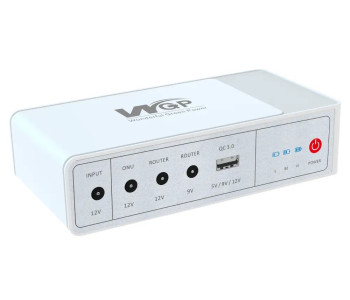
The WGP Mini UPS range is the name most people already search for by brand, and it's earned that recognition through multi-port output and battery capacity that's genuinely built for longer outages — the kind of unit you'd pick if your area's load shedding runs on the longer side, or if you want one box covering both your router and your ONU.
The PC Power Mini UPS range takes the opposite approach — smaller, simpler, and built for people whose outages are shorter and more frequent rather than long and occasional. It's a sensible pick for a single router in a household that just needs to bridge short gaps rather than survive an hour-long cut.
If what you actually need sits outside this category entirely — say you're trying to back up a desktop computer or a monitor rather than a router — it's worth looking at CSI's broader UPS range, which includes Online UPS units for equipment that can't tolerate even a brief switching delay, and Offline UPS units for everyday home and office backup at a more modest cost.
A Few Things People Usually Ask Us
Can a mini UPS run my router all night during a long outage?
It depends on the battery capacity of the unit and how much power your router draws, but most mini UPS models are designed for several hours of continuous backup rather than an entire night — checking the capacity against your typical outage length is the best way to judge fit.
Is it safe to leave a mini UPS plugged in all the time?
Yes — mini UPS units are designed to stay connected continuously, trickle-charging the battery and switching over automatically only when mains power is lost.
Can one unit back up both my router and my CCTV camera?
Only if the mini UPS has separate output ports matching each device's voltage requirement and enough combined capacity to run both — otherwise it's usually better to size the unit to whichever device matters more during an outage.
What's the real difference between a mini UPS and a regular UPS?
A regular UPS converts battery power into AC to run larger equipment like desktops and monitors, while a mini UPS delivers low-voltage DC power directly to small devices like routers and ONUs, with no conversion step involved.
Does CSI deliver mini UPS units outside Dhaka?
Yes, CSI ships nationwide across Bangladesh, with packaging built for battery-based electronics.
If you're still deciding between the WGP and PC Power ranges, tell CSI's support team what you're backing up and roughly how long your outages tend to run — it's a two-minute conversation that saves you from buying more, or less, than you actually need.



- Battery Capacity: 8800mAh
- Total Output: Max 18W
- Ports: 1x USB, 2x DC
- Protection: Over-Charge, Over-Discharge, etc


- Battery Type: 18650 li ion battery
- Color: White
- UPS Volume: 116*73*23.5mm


- Input Voltage : 5V
- Output Voltage : 5V-1A, 12V-1A
- Battery : 10400mAh


- Battery Type: 21700 li-ion
- Output Ports: 6
- Dimension: 105 x 105 x 28 mm


- Battery Type: 18650 li-ion
- Output Ports: 3
- Dimension: 110 x 73 x 24 mm